


Q&A with Sun Bo, Inspur: What Edge Computing Is Required for Smart‑Manufacturing Enterprises
#Industry information ·2021-07-24 11:40:58


By Huang Haifeng
Against the backdrop of enterprise digital‑transformation initiatives, the manufacturing industry is upgrading toward smart manufacturing. Meanwhile, advances in smart‑manufacturing equipment have become a core focus of industrial upgrading. According to Askci Consulting, the output value of China’s smart‑manufacturing equipment sector will reach RMB 2 trillion in 2021.
Progress in smart manufacturing relies not only on stable network infrastructure but also on sufficient computing power. “For manufacturing to achieve upgrading, computing power must take the lead,” commented Sun Bo, General Manager of the Edge Computing Business Unit at Inspur, at the Spark Liaoyuan Seminar on Smart‑Manufacturing Technology & Application held recently.
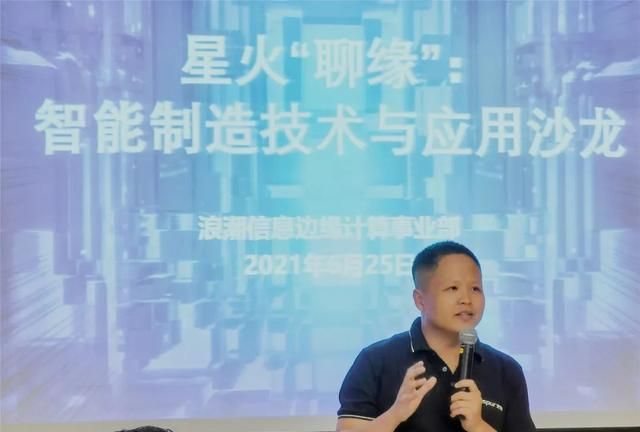
It is understood that the development of smart manufacturing has not been plain‑sailing. It still stays in its early‑stage development due to multiple bottlenecks within the computing segment. To accelerate industrial intelligence, manufacturers have put forward diverse computing‑related requirements.
Positioned close to on‑site factory data sources, edge computing works in synergy with cloud computing to drive intelligence for factory systems and ease pressure brought by various smart factory applications on bandwidth, data centers and security.
So what computing‑related challenges and demands are manufacturers facing at present? How can edge computing achieve widespread adoption within smart manufacturing?
Three Major Challenges for Manufacturers in the Smart‑Manufacturing Era
Smart manufacturing represents a long‑term vision for the manufacturing sector. China’s smart‑manufacturing industry has formed four major industrial clusters: the Yangtze River Delta, Pearl River Delta, Bohai Rim, and Central‑Western China.
Nevertheless, according to Sun Bo, manufacturers are confronted with three key challenges in their intelligence transformation.
First, the challenge of diverse and complex computing power. As deep learning evolves, the AlexNet classification algorithm requires 720 FLOPS to process 224×224 images. ResNet50, widely deployed for video processing in real‑world production, demands dozens of times more computing capacity than AlexNet, resulting in continuously rising complexity.
Second, the challenge of massive‑data interoperability. It is no easy task for smart‑manufacturing transformation to realize innovative scenarios such as intelligent production, personalized customization and network‑based collaboration. For instance, within smart equipment industries, domestic robot installations have surged from 250 000 units in 2015 to 1 000 000 units today. The market size for CNC machine tools and PLCs has expanded from RMB 140 billion to over RMB 200 billion. System portfolios have expanded from human‑centric systems including ERP, OA, CRM and SCM to object‑centric platforms such as IIoT, MES, WMS, PLM and QMS. Interoperability across heterogeneous data sources poses enormous difficulties.
Third, the challenge of high‑concurrency real‑time processing. Driven by advances in machine vision, assembly robots are widely adopted in smart manufacturing. Target recognition and trajectory planning for these intelligent robots impose higher requirements for real‑time performance, computational complexity and high‑concurrency computing capacity.
For example, a single high‑definition camera on an industrial shop floor generates roughly 330 GB of video data per day. A factory may deploy thousands of such cameras. Transmitting all this data to the cloud would consume massive bandwidth and fail to satisfy real‑time business requirements.

Edge Computing Emerges as a Key Enabler for Smart‑Manufacturing Development
According to the 2020 Global Computing Power Index Report jointly released by Inspur and IDC, the manufacturing sector ranks second globally in computing‑power investment and represents the largest traditional industry in terms of computing‑power spending. Among the world’s top 2000 manufacturing enterprises, computing‑power investment is mainly concentrated in R&D, production, supply chain, services and other segments.
Some research forecasts that more than 50 billion devices would be interconnected by 2020, and each factory would collect over 1.44 billion data points daily. This translates into unprecedented requirements and expectations for computing capacity, service speed and service quality within smart factories.
It is evident that computing power must take the lead for manufacturing‑industry upgrading. For legacy factories to acquire robust computing capabilities, they have to build large‑scale on‑premises data centers or obtain computing resources from remote data centers via network bandwidth and cloud services.
Given the three major challenges mentioned above, as well as issues such as transmission latency and data security inherent in conventional computing solutions, the manufacturing industry is in need of a better partner to supply computing power.
This is where edge computing stands out. As an extension of intelligent computing power from data centers toward the edge side, edge computing addresses core requirements of manufacturers including data interoperability, real‑time business execution, data optimization and application‑level intelligence.
Edge computing enables intelligent operation and management at the control layer, massive‑data analysis and mining at the integration layer, and low‑latency diagnosis and early‑warning capabilities at the perception layer. For deep‑learning use‑cases such as component identification and defect detection on factory production lines, bearing fault diagnosis, thermal anomaly detection for steel furnaces, and power‑equipment maintenance, edge computing delivers low‑latency diagnosis and early warnings. It improves production‑inspection efficiency and shortens order‑delivery cycles.
In fact, China still has substantial ground to cover when comparing its manufacturing capabilities with leading manufacturers in Europe, the United States and other regions. One key bottleneck is insufficient computing power on the edge side when Chinese manufacturers deploy industry applications built upon AI, IoT and related technologies.
Therefore, edge computing constitutes a critical pillar for the rapid advancement of smart manufacturing and calls for vigorous industry‑wide development and deployment.

Edge‑Computing Deployment in Manufacturing Faces Roadblocks
Edge computing is still undergoing rapid evolution. Dr. Song Ping, Senior Project Manager at the Internet Center of the Institute of Technology and Standards, China Academy of Information and Communications Technology (CAICT), shared with the author that 80 % of data generation and computing will take place at the edge and end‑devices in the digital era, and the edge‑computing market will grow to the scale of tens or even hundreds of billions in the future.
Despite the booming edge‑computing industry, manufacturing plants still need to resolve several critical pain‑points when rolling out edge‑computing solutions.
First, there exists a disconnect between AI technologies and manufacturing‑industry value chains. While AI algorithms and models have become increasingly mature, manufacturers lack skilled AI talent for practical implementation. Meanwhile, leading AI research institutions and tech companies lack real‑world scenarios and key industry‑specific data.
Survey reports from consulting firms including Accenture show that over 70 % of technically‑proficient research institutes and tech companies are short of business scenarios, domain expertise and industry data, whereas more than 70 % of industrial end‑users lack technical talent, AI platforms and hands‑on implementation capabilities. This gap greatly hinders the progress of smart‑manufacturing adoption.
“Algorithm engineers mostly come from research institutes or elite R&D teams at internet firms, and they lack hands‑on exposure to real‑world industrial scenarios,” Sun Bo commented. Edge computing must be tightly coupled with use‑cases. Only by configuring diverse hardware, connecting various sensors and deploying tailored solutions can we truly address on‑site client requirements — in other words, delivering differentiated solutions built around customer needs.
Second, full‑fledged end‑to‑end solutions for cloud‑edge resource management and task scheduling for cloud‑edge collaboration are lacking. As the core of edge‑computing architectures shifts toward the cloud, enterprises demand complete hardware‑and‑software stacks covering algorithms, cloud platforms, edge‑resource management platforms and hardware products.
According to Dr. Song Ping from CAICT, cloud‑edge collaboration embodies the core value of edge computing from a core‑technology perspective. Closer multi‑dimensional coordination should be realized across cloud, edge and end layers. At present, edge computing mainly advances cloud‑network integration centered on the cloud to build unified cloud‑network capabilities. In the future, cloud‑native technologies will act as an accelerator for edge‑computing development and further boost heterogeneous computing power.
Third, consumer‑grade computing products deployed inside factories suffer poor reliability. Today’s edge‑computing devices are not sufficiently mature and stable. For instance, traditional industrial PCs or compact edge boxes deployed in factories used to require 10‑minute downtime every week, indicating poor stability. The root cause lies in desktop‑grade chips adopted in hardware design, which cannot guarantee stable and continuous operation under outdoor deployment conditions.
Sun Bo cited a real‑world case: one customer raised concerns prior to building smart manufacturing facilities. If computing systems fail, intelligent machines would grind to a halt. A single smart machine delivers output equivalent to six human workers. Should production stop due to unstable computing hardware, how would the plant handle delayed schedules and insufficient production capacity?
Therefore, the industry needs to remove all kinds of obstacles holding back edge‑computing adoption in manufacturing and eliminate concerns of plant owners pursuing smart‑manufacturing transformation.

1. Intelligent Inspection Solution: The “All-Seeing Eyes” of Smart Factories
2. Intelligent Diagnosis Solution for Industrial Robots
3. 24/7 Intelligent Safety Supervision Solution